We usually reply within a few hours.
From high mountain passes and glacial valleys beneath Mount Kazbek to ancient vineyards, qvevri cellars and long Georgian feasts in Kakheti.
Georgia is a country where some of its most dramatic landscapes and oldest traditions exist surprisingly close together.
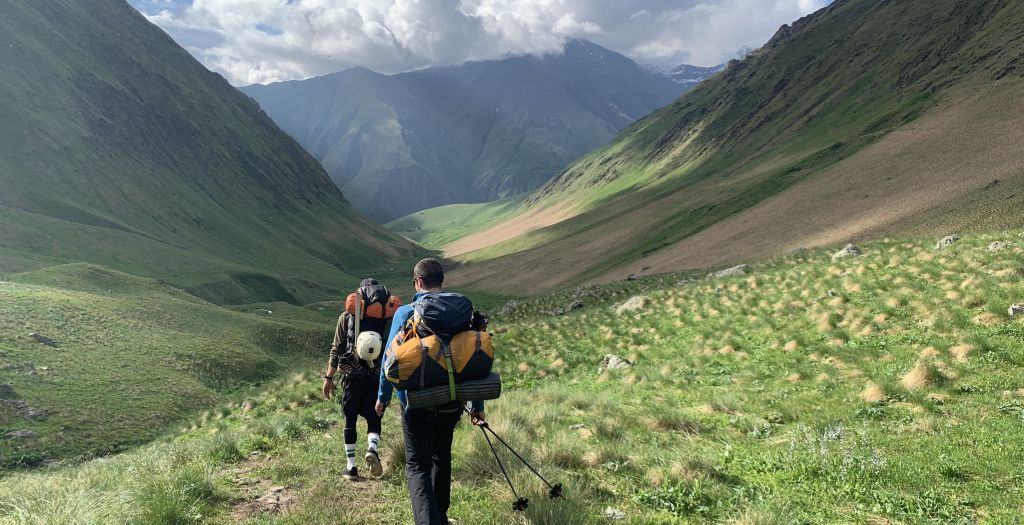
In the north, the Greater Caucasus rises into a wild world of enormous peaks, deep valleys, alpine meadows and glaciers. Here, we leave the roads behind and spend four days exploring the mountains around Stepantsminda — hiking beneath the jagged Chaukhi massif, crossing high mountain terrain, spending a night at 3,014 metres in a remote mountain hut, and walking towards the Gergeti Glacier beneath the legendary Mount Kazbek.
But Georgia is not only a country of mountains.
As we descend from the Caucasus and travel east, the landscape changes completely. The high peaks give way to broad valleys covered with vineyards, historic villages and centuries-old monasteries. This is Kakheti — Georgia’s great wine region and the heart of one of the world’s oldest wine-making cultures.
For the final two days, we trade our hiking boots for wine glasses and explore the vineyards and cellars of Kakheti. We visit traditional family wineries, discover the ancient qvevri method of winemaking, taste Georgian wines ranging from distinctive amber wines to powerful Saperavi, and share long meals around tables filled with local food.
The contrast is what makes this journey special.
One day you are standing beneath a glacier at more than 3,000 metres, surrounded by some of the highest mountains in the Caucasus. A day later, you are sitting among vineyards in the Alazani Valley, looking back towards those same mountains with a glass of Georgian wine in your hand.
This is a journey through two very different sides of Georgia — from the high Caucasus to the wine country, from trekking to feasting, and from wild mountain landscapes to some of the country’s oldest traditions.
Six days. Two worlds. One journey through Georgia.
Duration: 6 days / 5 nights
Regions: Tbilisi – Kazbegi / Stepantsminda – Kakheti
Mountain section: 4 days
Wine & culture: 2 days
Highest altitude: approximately 3,300 m
Mountain accommodation: Stepantsminda + Altihut 3014
Wine region: Kakheti / Alazani Valley
Hike through the dramatic Chaukhi Mountains
Reach approximately 3,338 m at Chaukhi Pass
Discover the colourful Abudelauri Lakes
Walk beneath the legendary Mount Kazbek
Spend a night at Altihut 3014
Hike towards the Gergeti Glacier
Explore Gveleti Waterfalls
Discover historic Sighnaghi
Visit Bodbe Monastery
Experience traditional qvevri winemaking
Taste Georgian amber wine and Saperavi
Explore Tsinandali Estate
Visit Alaverdi Monastery
Eat traditional Kakhetian food in local wineries and family cellars
Good fitness and previous full-day hiking experience are recommended. You should be comfortable hiking 5–7 hours on mountainous terrain, including steep and uneven sections, and hiking at altitudes up to 3,300 m.
No technical climbing or mountaineering experience is required.
Fitness Level: You should be comfortable with hiking 6-8 hours daily, often on uneven and sometimes steep terrain. A good level of cardiovascular fitness, balance, and endurance will ensure you fully enjoy each day’s trek.
Previous Trekking Experience: Some experience with multi-day hiking and carrying a day pack is helpful. While you won’t need advanced mountaineering skills, being familiar with basic hiking practices, such as pacing and managing energy, will make this trek enjoyable.
Mental Preparedness: Kazbegi’s trails can be remote, and the mountain weather is changeable. A sense of adventure, adaptability, and preparedness for different weather conditions will enhance your experience.
| OPEN DATES | OPEN DATES | OPEN DATES | OPEN DATES |
|---|---|---|---|
| June | July | August | September |
| 21-29 | 12-20 | 16-24 | 6-14 |
| 27 – 5 October | |||
Hiking: Gveleti Waterfalls
Difficulty: Easy
Overnight: Stepantsminda
We leave Tbilisi and head north along the historic Georgian Military Highway, following the Aragvi valley towards the Greater Caucasus.
As the landscape changes, the road climbs towards the mountains and the peaks become increasingly dominant.
After arriving in Stepantsminda, we check into our mountain hotel and take some time to settle in.
In the afternoon, we make our first short hike into the spectacular Dariali Gorge to Gveleti Waterfalls.
The trail leads through a rugged landscape of cliffs, streams and alpine vegetation before reaching the waterfalls. There are actually two waterfalls — the larger cascade is around 30 metres high. The trailhead is only around 7 km from Stepantsminda, making this an ideal first hike after the drive.
It is deliberately a relatively easy start. The goal is to stretch the legs, breathe mountain air and begin the transition from the city to the Caucasus.
Evening: Dinner in Stepantsminda and overnight.
Hiking: Full day
Difficulty: Moderate / Challenging
Highest point: ~3,338 m
Overnight: Stepantsminda
Today we leave the main valley behind and drive into the remote Sno Valley towards Juta.
At approximately 2,100–2,200 metres, Juta is one of the highest inhabited villages in the region. Above it rises the spectacular Chaukhi Massif — a wall of sharp granite and limestone towers often compared to the Dolomites.
From the village we begin walking into the Chaukhi valley.
The trail initially crosses open mountain meadows before becoming steeper as we approach the massif. Juta Lake appears below the cliffs, while the seven distinct peaks of Chaukhi rise dramatically above the valley.
We continue towards Chaukhi Pass, reaching approximately 3,338 metres.
Beyond the pass lies Khevsureti and the famous Abudelauri Lakes — three striking alpine lakes known for their white, blue and green colours.
For this itinerary, we will adapt the exact turnaround point according to weather, trail conditions and the group’s fitness. We do not need to force a full Juta–Roshka crossing to experience the best of the landscape.
After a long day in the mountains, we return to Juta and drive back to Stepantsminda.
Evening: Dinner and overnight in Stepantsminda.
Hiking: Full day
Difficulty: Moderate / Challenging
Highest point: 3,014 m
Overnight: Altihut
Today the adventure moves higher.
We begin from Gergeti Trinity Church, one of Georgia’s most spectacular mountain landmarks, standing high above Stepantsminda with Mount Kazbek dominating the skyline.
From Gergeti we leave the village behind and follow the classic mountain route towards the Kazbek glacier.
The landscape changes quickly.
Trees disappear. The valley opens. The trail climbs through increasingly barren alpine terrain, with the enormous walls of Kazbek and the surrounding peaks becoming closer with every step.
Our destination is Altihut, located at 3,014 metres and close to the first acclimatization zone on the route towards Mount Kazbek. The hut offers comfortable accommodation, food and a unique place to spend the night high in the Caucasus.
We arrive in the afternoon and have time to relax on the terrace, enjoy dinner and watch the mountains change colour as the sun disappears behind the peaks.
Tonight we sleep at more than 3,000 metres.
Overnight: Altihut 3014.
Hiking: Full morning / early afternoon
Difficulty: Moderate / Challenging
Highest point: ~3,200–3,300 m
Overnight: Kakheti
We wake above the clouds.
After breakfast, we continue higher towards the Gergeti Glacier, following the route deeper into the high Caucasus.
The glacier lies approximately 2 km beyond Altihut. From here the views towards Mount Kazbek and the surrounding glaciated peaks become increasingly dramatic.
We spend time in the high mountains before turning around and beginning our long descent towards Stepantsminda.
This is the final mountain day — and a satisfying one. Within a few hours we move from the alpine world back into the green valleys below.
After reaching Stepantsminda, we meet our vehicle and begin the journey east.
The landscape changes again as we cross Georgia towards Kakheti, the country’s most important wine-producing region.
By evening we arrive at our accommodation among the vineyards.
The mountains are behind us.
The wine country begins.
Activity: Cultural & wine experience
Overnight: Kakheti
After four days in the mountains, today is deliberately slower.
We begin in Sighnaghi, one of Georgia’s most beautiful historic towns.
Perched above the Alazani Valley, Sighnaghi is surrounded by historic defensive walls and offers spectacular views across the vineyards towards the Greater Caucasus.
We walk through the old town and along the historic walls before continuing to Bodbe Monastery, one of the most important religious sites in the region.
Then we get to the real reason we came to Kakheti.
Wine.
Instead of spending the day visiting large commercial wineries, we prefer to take guests into a traditional family cellar, where wine is still made using the ancient Georgian qvevri method.
The qvevri are large clay vessels buried underground in which the wine ferments and matures.
This is not simply a wine tasting.
It is an introduction to one of the oldest continuous wine-making traditions in the world. The Georgian qvevri tradition has been recognized by UNESCO as intangible cultural heritage.
We meet the winemaker, visit the cellar and taste a selection of Georgian wines — including traditional amber wines and Saperavi.
And then we sit down for lunch.
Georgian wine is inseparable from Georgian food, so the tasting becomes a long table of local dishes, fresh bread, cheese, seasonal vegetables, grilled meat and, depending on the season, traditional Kakhetian specialties.
This is the moment to slow down.
After days of walking, there is nowhere else we need to be.
Overnight: Kakheti.
Activity: Wine & cultural experience
End: Tbilisi
Our final day explores the heart of Kakheti’s wine country.
We travel through the Alazani Valley, with the Greater Caucasus rising dramatically on the northern horizon.
Our first major stop is Tsinandali, the historic estate of Prince Alexander Chavchavadze.
Tsinandali represents an important chapter in the transformation of Georgian wine and the introduction of European-style winemaking to Georgia. The estate also houses a historic wine cellar and extensive gardens.
From Tsinandali we continue through the wine country towards Alaverdi, an extraordinary 11th-century cathedral standing almost alone in the middle of the Alazani Valley.
The monastery has a long connection with Georgian winemaking and maintains its own traditional wine cellar.
After exploring Alaverdi, we continue to a carefully selected winery for our final tasting and lunch.
This final experience is less about ticking off another winery and more about finishing the journey properly — good wine, Georgian food, mountain views and time around the table.
In the afternoon, we begin our return journey towards Tbilisi.
As the vineyards disappear behind us, the journey comes full circle.
Six days earlier we left the capital heading towards the mountains.
Now we return from the Caucasus with muddy boots, a few bottles of Georgian wine and a completely different perspective on the country.